
































Arbitrage trading in forex seeks to profit from temporary inconsistencies between currency prices. Rather than forecasting whether a currency will rise or fall, the trader attempts to buy an identical or economically equivalent exposure at the lower executable price while selling it at the higher one.
Forex is distributed across banks, liquidity providers, electronic venues and brokers rather than one centralized exchange. Quotes can therefore differ briefly because of timing, available liquidity, account markups or data-feed delays. Related currency pairs, spot rates, forward prices and futures contracts can also move out of alignment.
Finding different prices is only the beginning. A viable opportunity must remain profitable after the correct bid and ask prices, available trade size, execution delays, spreads, commissions, slippage, financing and account-rebalancing costs are considered.
Key Takeaways
- Forex arbitrage targets inconsistent pricing rather than market direction.
- The main methods are cross-broker, triangular, covered interest and spot-futures arbitrage.
- Calculations must use synchronized, executable bid and ask prices.
- A discrepancy becomes useful only when every required transaction can be completed profitably after costs.
- Retail traders can study and test arbitrage relationships, but reliable execution often requires accurate data, sufficient capital and automated order management.
What Is Arbitrage Trading in Forex?
Forex arbitrage is the attempt to capture a pricing inconsistency involving the same currency exposure or a set of economically connected transactions.
The simplest example occurs when two brokers quote different executable prices for the same currency pair. A trader may try to buy through the cheaper venue while selling the same amount through the more expensive one.
A triangular opportunity involves three related pairs. EUR/USD, EUR/GBP and GBP/USD should maintain a consistent relationship because each pair connects two of the same three currencies. When the quoted cross-rate differs sufficiently from the rate implied by the other pairs, a profitable conversion loop may briefly appear.
Other forms compare spot currencies with forward contracts, interest rates or currency futures. Although the instruments differ, the underlying objective remains the same: capture a pricing difference without relying primarily on a prediction about future market direction.
Arbitrage vs Directional Forex Trading
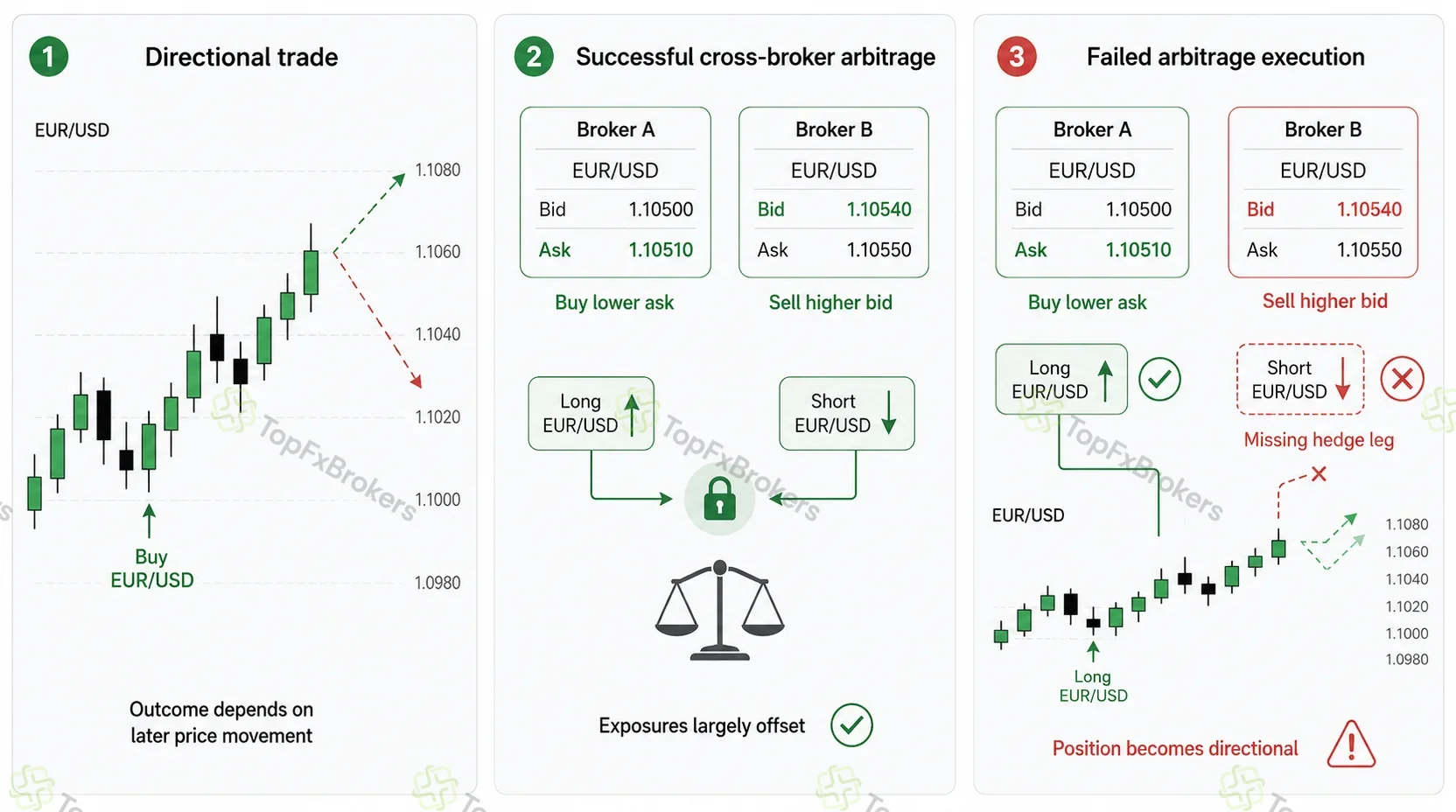
A directional trader buys EUR/USD because the euro is expected to strengthen against the dollar. The result depends on what happens after the position is opened.
A cross-broker arbitrage trader may instead buy EUR/USD through one broker and sell the same amount at a higher price through another. When both orders fill as expected, the long and short exposures largely offset.
That neutrality is conditional. A filled purchase without the corresponding sale leaves the trader long EUR/USD. The position then behaves like an ordinary directional trade until the missing hedge is established or the first order is closed.
For this reason, execution is not merely an administrative step. It is part of the forex arbitrage strategy itself.
Why Forex Price Discrepancies Appear
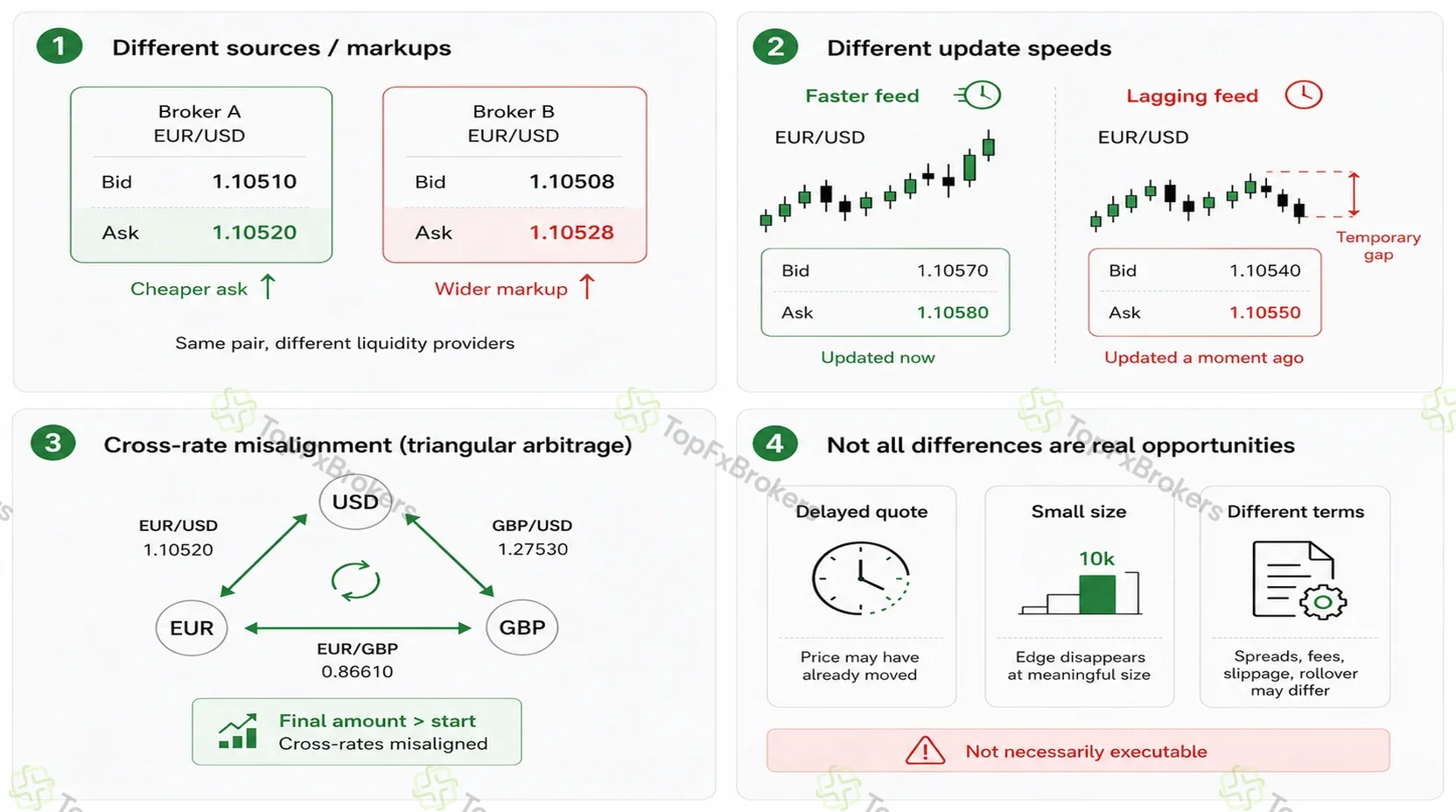
There is no single universal retail forex price. Brokers and venues receive quotes from different liquidity sources, apply different markups and update their platforms at different speeds.
During calm conditions, these variations may be too small to trade. During rapid price movement, one feed may adjust before another, causing a temporary difference.
Related currency pairs can also become misaligned. If the price of converting dollars into euros, euros into pounds and pounds back into dollars produces more than the starting amount, the three markets are not fully consistent.
Some visible differences are not genuine opportunities. A quote may be delayed, indicative rather than executable or available only for a small quantity. Two products carrying the same currency-pair symbol may also have different financing, margin or settlement terms.
Main Types of Forex Arbitrage
Four methods are widely associated with the foreign-exchange market. Cross-broker and triangular arbitrage are the most relevant to general spot forex traders. Covered interest and spot-futures arbitrage involve additional funding or derivative-market considerations.
| Type | Pricing relationship | Main transactions | Main challenge |
|---|---|---|---|
| Cross-broker arbitrage | The same currency pair across separate venues | Two opposing positions | Coordinating fills and rebalancing accounts |
| Triangular arbitrage | Three connected currency pairs | Three conversions | Correct quote direction and completion of every leg |
| Covered interest arbitrage | Spot rate, interest rates and forward rate | Borrowing, conversion, investment and forward hedge | Access to realistic funding and forward prices |
| Spot-futures arbitrage | Spot currency and currency futures | Opposing spot and futures positions | Financing, contract matching, basis and expiry |
How to Identify a Forex Arbitrage Opportunity
A price scanner may find hundreds of differences, but only a small portion may be executable. Identifying a genuine opportunity requires several layers of validation.
The first question is whether the prices represent the same or economically equivalent exposure. Comparing EUR/USD across two brokers can be meaningful when the contract sizes, account conditions and settlement arrangements are compatible. Comparing a rolling spot contract with a currency future requires adjustments for financing, expiry and contract specifications.
The correct side of every quote must then be applied. A trader buying the base currency pays the ask. A trader selling it receives the bid. Calculations based on midpoints, chart closes or last-traded prices can show profits that were never available.
Timing is equally important. Quotes need to represent the same market moment. A current price from one venue compared with a price that is several hundred milliseconds old can create an artificial discrepancy.
Available size must also be confirmed. A favorable price displayed for €10,000 does not support a €100,000 transaction. In a multi-leg strategy, the smallest executable amount across the required orders determines the maximum practical size.
Finally, the gross difference must be converted into a net edge. The calculation should deduct spreads, commissions, expected slippage, financing, closure costs and any expense involved in transferring or rebalancing funds. A safety allowance may also be needed because completed prices rarely match detected prices perfectly.
It helps to distinguish four stages:
Raw discrepancy: Prices appear inconsistent.
Theoretical opportunity: The relationship produces a positive result in a calculation.
Executable opportunity: Synchronized bid and ask quotes, sufficient size and estimated costs still leave a positive edge.
Completed arbitrage: Every required order fills, the remaining exposure is neutralized and an actual net profit remains.
Confusing these stages can make a weak strategy look much more successful than it is.
Cross-Broker Forex Arbitrage
Cross-broker arbitrage, also known as locational arbitrage, attempts to exploit a difference in the same currency pair across two venues.
The trader buys through the venue offering the lower executable ask and sells the same amount through the venue offering the higher executable bid.
The opportunity exists only when the higher bid exceeds the lower ask by enough to cover all remaining costs.
Worked Cross-Broker Arbitrage Example
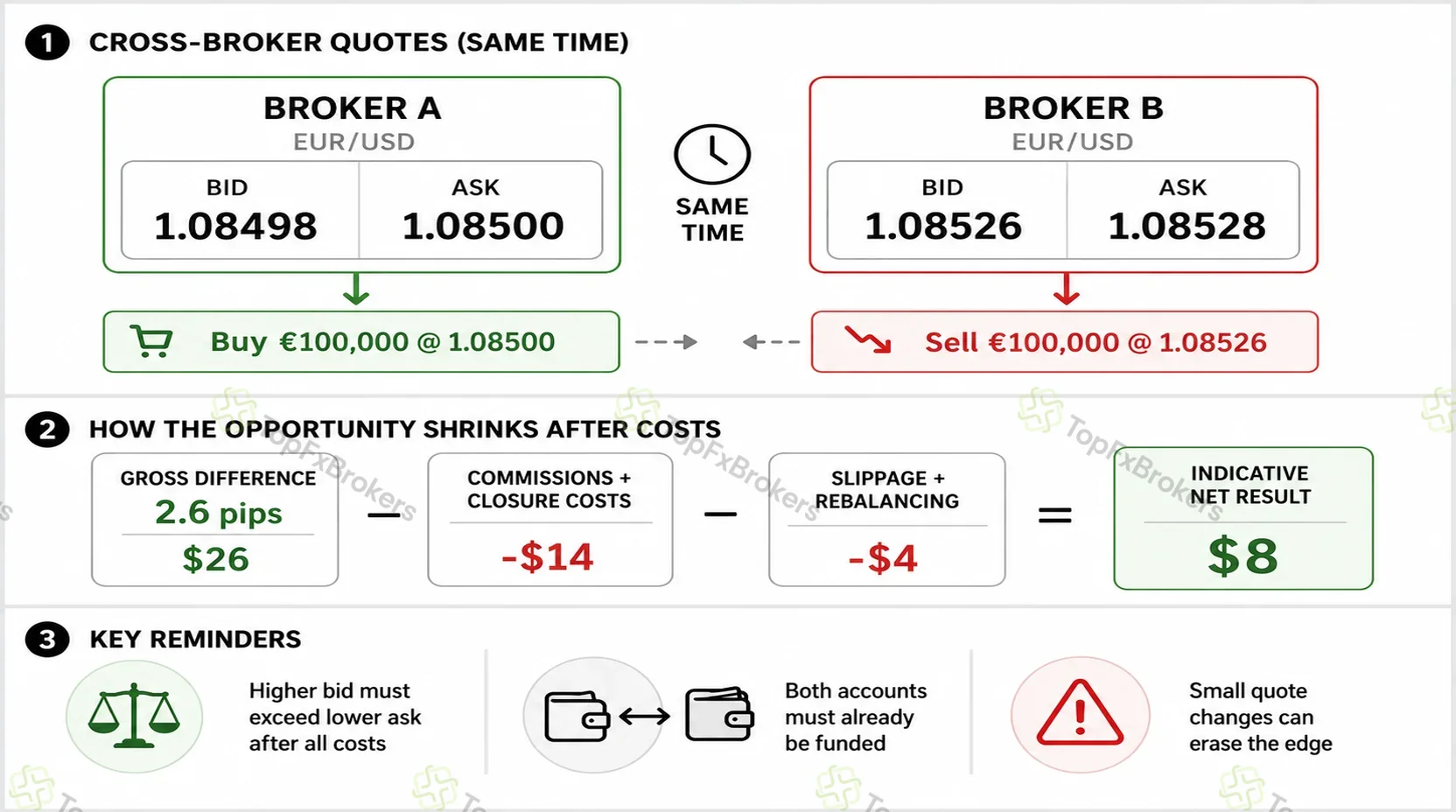
Assume two brokers display the following EUR/USD quotes at the same time:
| Item | Broker A or calculation | Broker B or result |
|---|---|---|
| Bid | 1.08498 | 1.08526 |
| Ask | 1.08500 | 1.08528 |
| Trade | Buy €100,000 at 1.08500 | Sell €100,000 at 1.08526 |
| Gross difference | 2.6 pips | $26 |
| Estimated commissions and closure costs | −$14 | |
| Estimated slippage and rebalancing | −$4 | |
| Indicative net result | $8 |
The visible difference is worth $26 on €100,000, but the estimated net result is only $8. A small quote change or an additional execution cost could remove the remaining advantage.
Both accounts would normally need to be funded before the opportunity appeared. Transferring capital after detecting the discrepancy would take too long.
Why Broker Quotes May Not Be Comparable
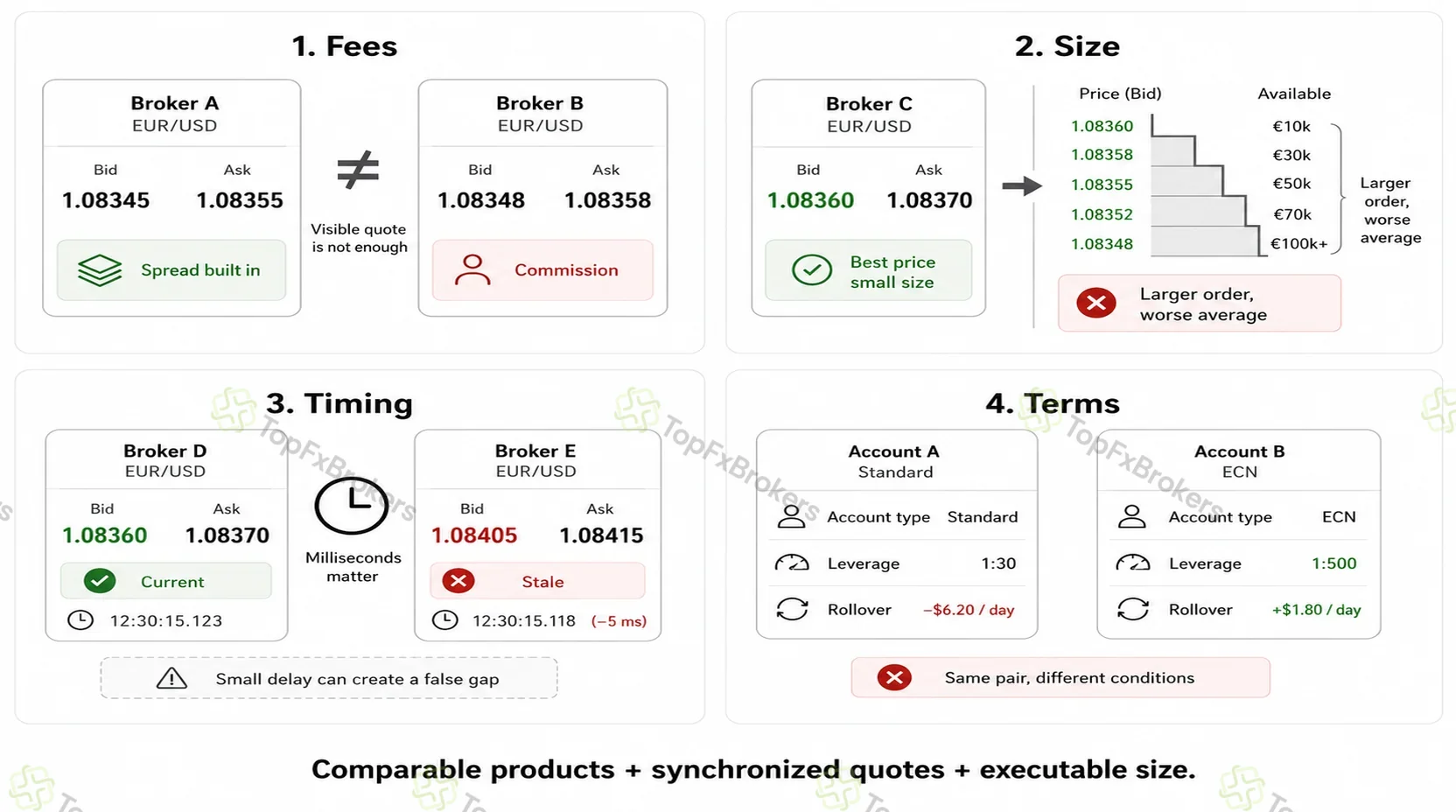
Two brokers can display EUR/USD while offering materially different conditions.
One may include its fee in the spread, while another charges a commission. A quote may apply only to a particular account type, deposit level or monthly trading volume. Leverage, contract size, rollover treatment and margin rules can also differ.
Liquidity is another concern. A high bid may be available for only a fraction of the intended order. A larger trade may fill across several price levels, producing a worse average sale price.
The timestamps must also be comparable. During fast conditions, quotes received milliseconds apart can describe different market states even when a platform displays them as simultaneous.
Cross-broker arbitrage is therefore not simply a search for the highest and lowest visible prices. It requires economically comparable products, synchronized data and confirmed executable size.
Closing the Positions and Rebalancing the Accounts
Opening a long position through one broker and a short position through another does not complete the operational process.
The combined market exposure may be neutral, but the positions remain open in separate accounts. They must eventually be closed, reduced through later trading or offset through account rebalancing.
Closing both positions at the same time involves crossing additional spreads. Those exit costs need to be included when deciding whether the original difference was large enough.
A trader who performs the strategy repeatedly may wait for a later opportunity in the opposite direction. New trades can then reduce existing positions rather than closing each one immediately. This may save some costs but leaves capital and margin tied up.
Profits and losses can also accumulate unevenly. One account may repeatedly gain while the other loses, even though the combined result is positive. The weaker account may eventually need additional funds to maintain sufficient free margin.
Transfers, withdrawals and currency conversions can introduce fees and delays. A realistic cross-broker calculation therefore includes both the initial price difference and the longer-term cost of maintaining balanced accounts.
Stale Quotes and Latency
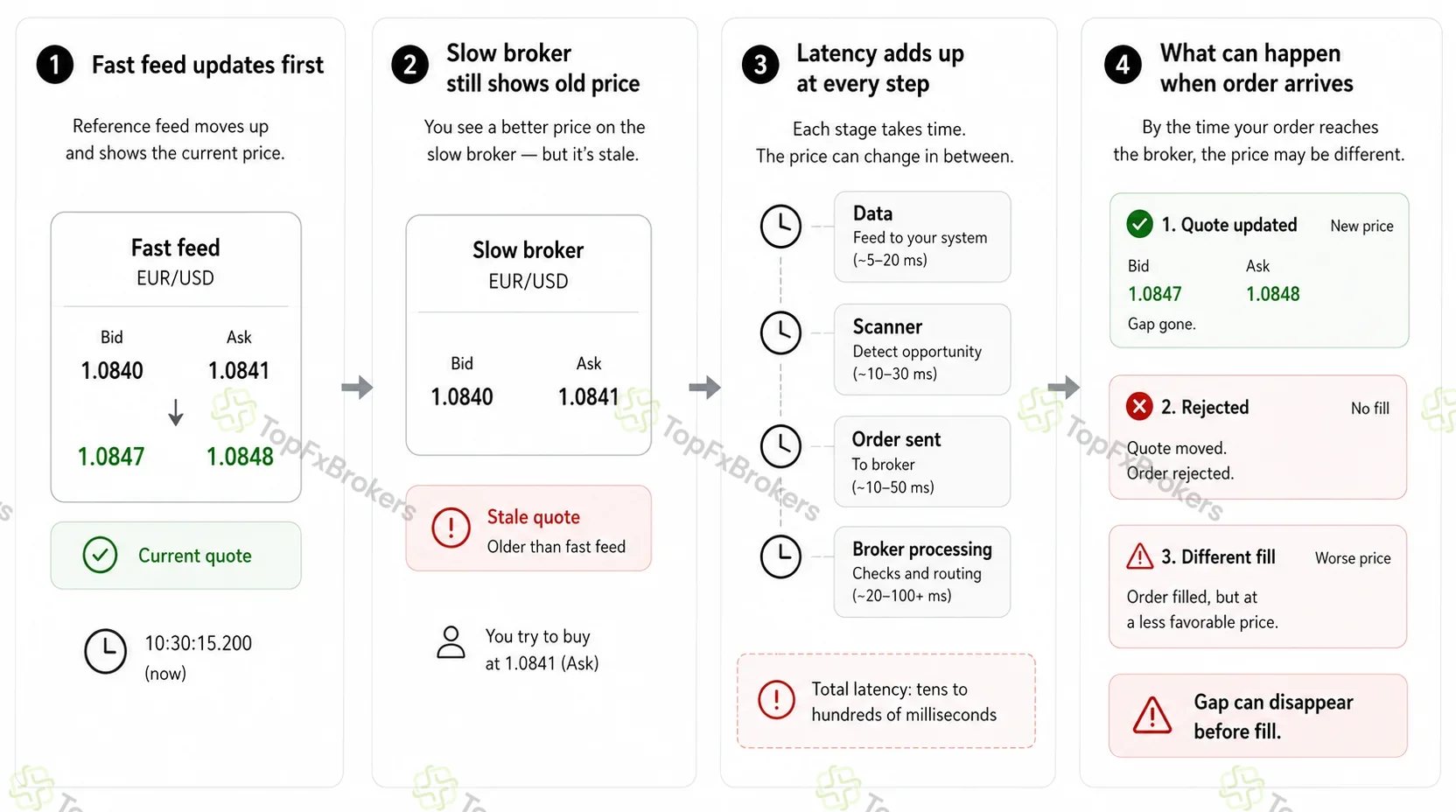
Some strategies attempt to trade against a broker whose quote updates more slowly than a faster reference feed.
The trader observes a movement on the faster source and submits an order against the older price. The method depends on the delayed quote remaining executable.
The broker may instead reject the order, update the price or return a different fill. Account agreements may also contain provisions covering stale prices, obvious errors, delayed feeds or particular automated trading practices.
Latency occurs throughout the process. Data must reach the trader, software must evaluate the difference, orders must travel to both venues and each venue must process them. The gap can disappear at any stage.
Triangular Arbitrage in Forex
Triangular arbitrage tests whether three connected currency pairs produce a consistent conversion relationship.
Consider:
- EUR/USD
- EUR/GBP
- GBP/USD
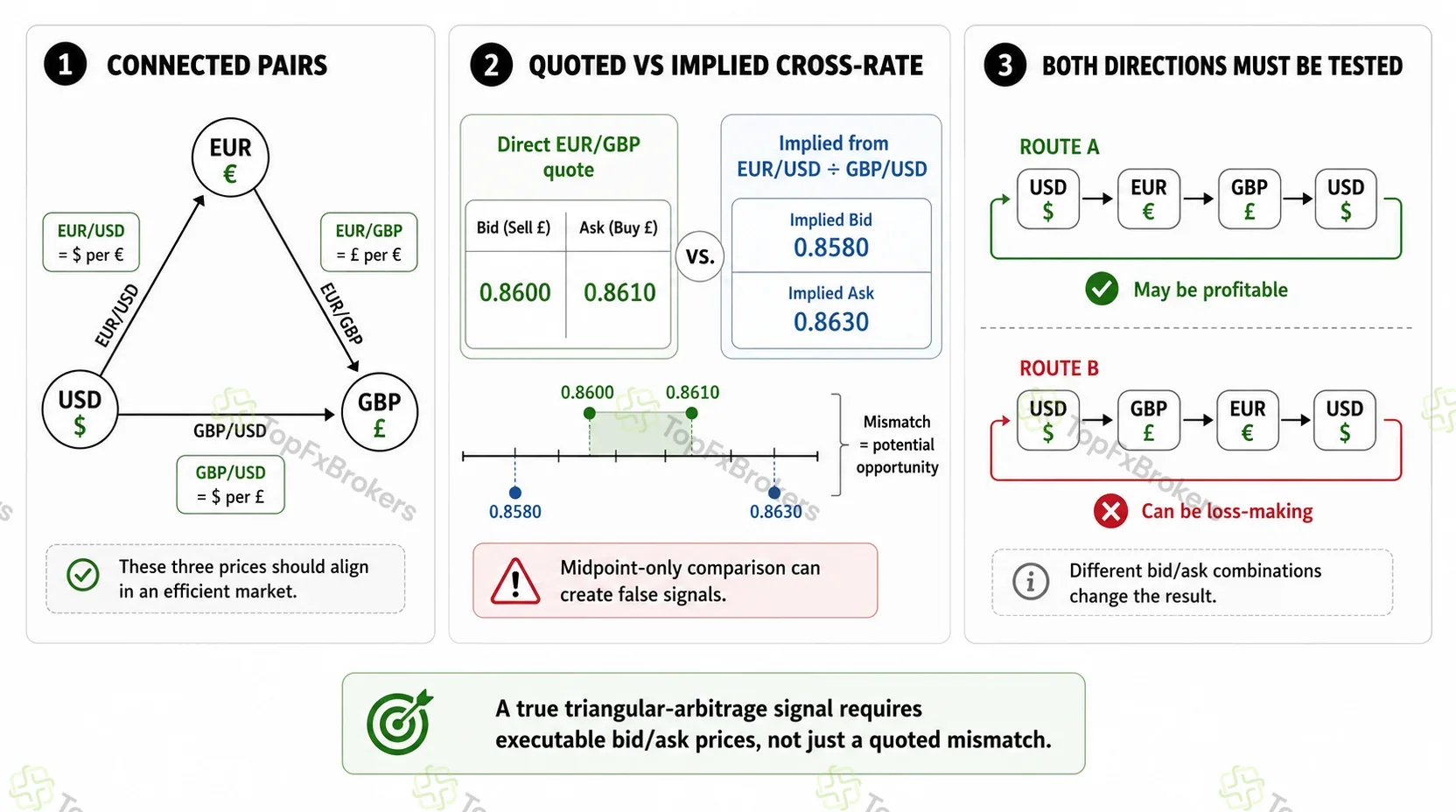
EUR/USD gives the dollar value of one euro. EUR/GBP gives the pound value of one euro. GBP/USD gives the dollar value of one pound.
These prices should remain aligned. When the directly quoted EUR/GBP market differs sufficiently from the cross-rate implied by EUR/USD and GBP/USD, a triangular arbitrage opportunity may appear.
Comparing the Quoted and Implied Cross-Rate
At a simplified level, EUR/GBP can be estimated by dividing EUR/USD by GBP/USD.
Live calculations require separate implied bids and asks because the available conversion price depends on the direction of the trade. A system that compares only midpoint rates may detect a difference that disappears after the relevant spreads are applied.
A complete calculator should also evaluate both possible routes from the starting currency:
The first route can be profitable while the second produces a loss because each path uses a different combination of bids and asks.
Choosing the Correct Side of Each Quote
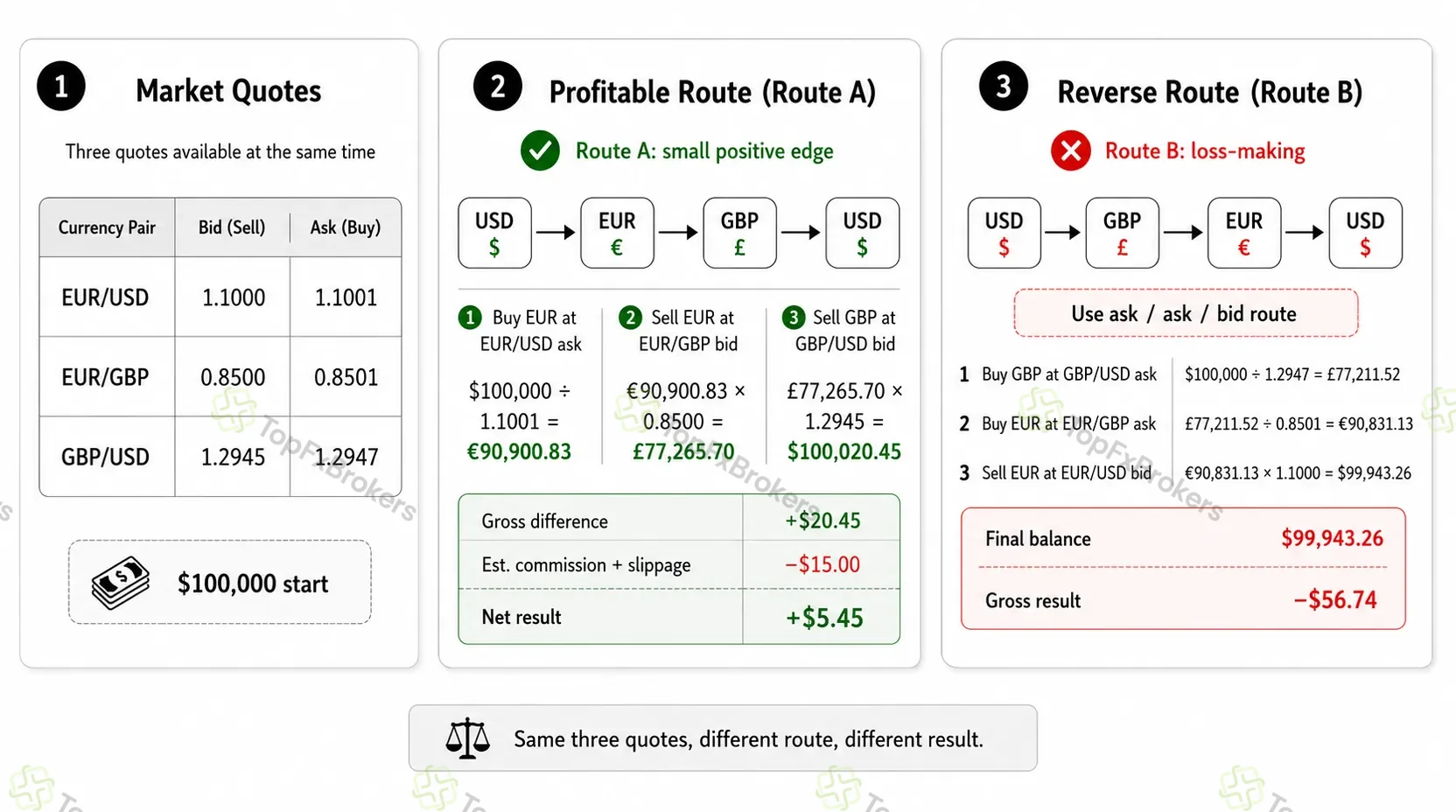
Suppose a trader begins with dollars and follows the first route.
To convert dollars into euros through EUR/USD, the trader buys euros and pays the EUR/USD ask.
To convert euros into pounds through EUR/GBP, the trader sells euros at the EUR/GBP bid.
To convert pounds back into dollars through GBP/USD, the trader sells pounds at the GBP/USD bid.
The simplest way to avoid mistakes is to ask at each stage:
Which currency do I own, which currency do I need, and am I buying or selling the base currency?
Quote Inversion
A currency pair may be quoted in the opposite direction from the one required.
Suppose EUR/GBP is quoted at 0.8500/0.8501. The equivalent GBP/EUR quote is not created by taking the reciprocal of each number while leaving it on the same side.
The reciprocal of the original ask becomes the new bid. The reciprocal of the original bid becomes the new ask.
The approximate inverted market would therefore be 1.17633/1.17647.
This reversal preserves the normal relationship in which the bid remains below the ask. Incorrect inversion can create a false arbitrage signal.
Worked Triangular-Arbitrage Example
Assume these quotes are available simultaneously:
| Stage or market | Bid/ask or calculation | Resulting balance |
|---|---|---|
| EUR/USD | 1.1000/1.1001 | |
| EUR/GBP | 0.8500/0.8501 | |
| GBP/USD | 1.2945/1.2947 | |
| Starting amount | $100,000.00 | |
| Buy EUR at EUR/USD ask | $100,000 ÷ 1.1001 | €90,900.83 |
| Sell EUR at EUR/GBP bid | €90,900.83 × 0.8500 | £77,265.70 |
| Sell GBP at GBP/USD bid | £77,265.70 × 1.2945 | $100,020.45 |
| Gross difference | $20.45 | |
| Estimated commission and slippage | −$15.00 | |
| Indicative net result | $5.45 |
The calculation produces only $5.45 after estimated costs on a $100,000 starting balance. A small quote movement, additional slippage or partial fill could eliminate it.
The reverse route produces a different outcome. Converting dollars into pounds at the GBP/USD ask, pounds into euros at the EUR/GBP ask and euros into dollars at the EUR/USD bid returns approximately $99,943.26. That route loses about $56.74 before additional fees.
The same three markets can therefore offer a small positive result in one direction and a clear negative result in the other.
Why Midpoint Calculation Are Misleading
A midpoint sits halfway between the bid and ask. It can be useful for analysis, but it is not normally the price available for an immediate trade.
Using midpoint rates removes part of each spread from the calculation. A triangular loop that appears profitable on mid-prices may become negative once the correct executable quote is used for every conversion.
Candle closes and last-traded prices create a similar problem. They do not necessarily represent the bid or ask available at the required size and time.
What Happens When One Leg Fails?
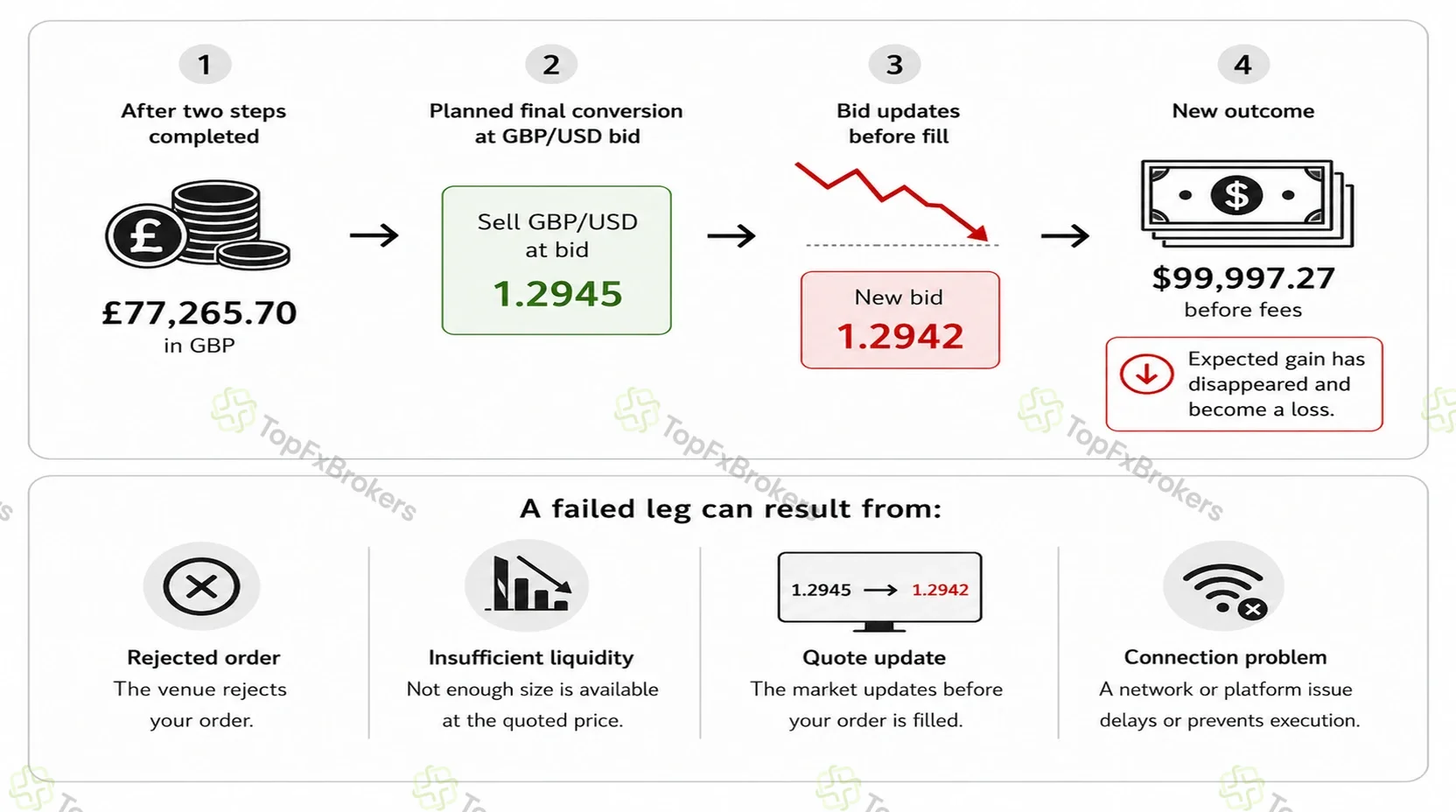
Suppose the trader has completed the first two conversions and holds £77,265.70. The plan is to sell those pounds at a GBP/USD bid of 1.2945.
Before the final order fills, the bid falls to 1.2942. The pounds now convert into approximately $99,997.27 before further fees.
The initial gross gain has become a loss. Until the final conversion is completed, the trader is exposed to further movement in GBP/USD.
A failed leg can result from a rejected order, insufficient liquidity, a quote update or a connection problem. The trader must then accept an unfavorable conversion or remain exposed while waiting.
Sequential manual execution is particularly vulnerable because the market may change before all three conversions are completed.
Covered Interest Arbitrage
Covered interest arbitrage compares the fully hedged returns available from borrowing and investing in two currencies.
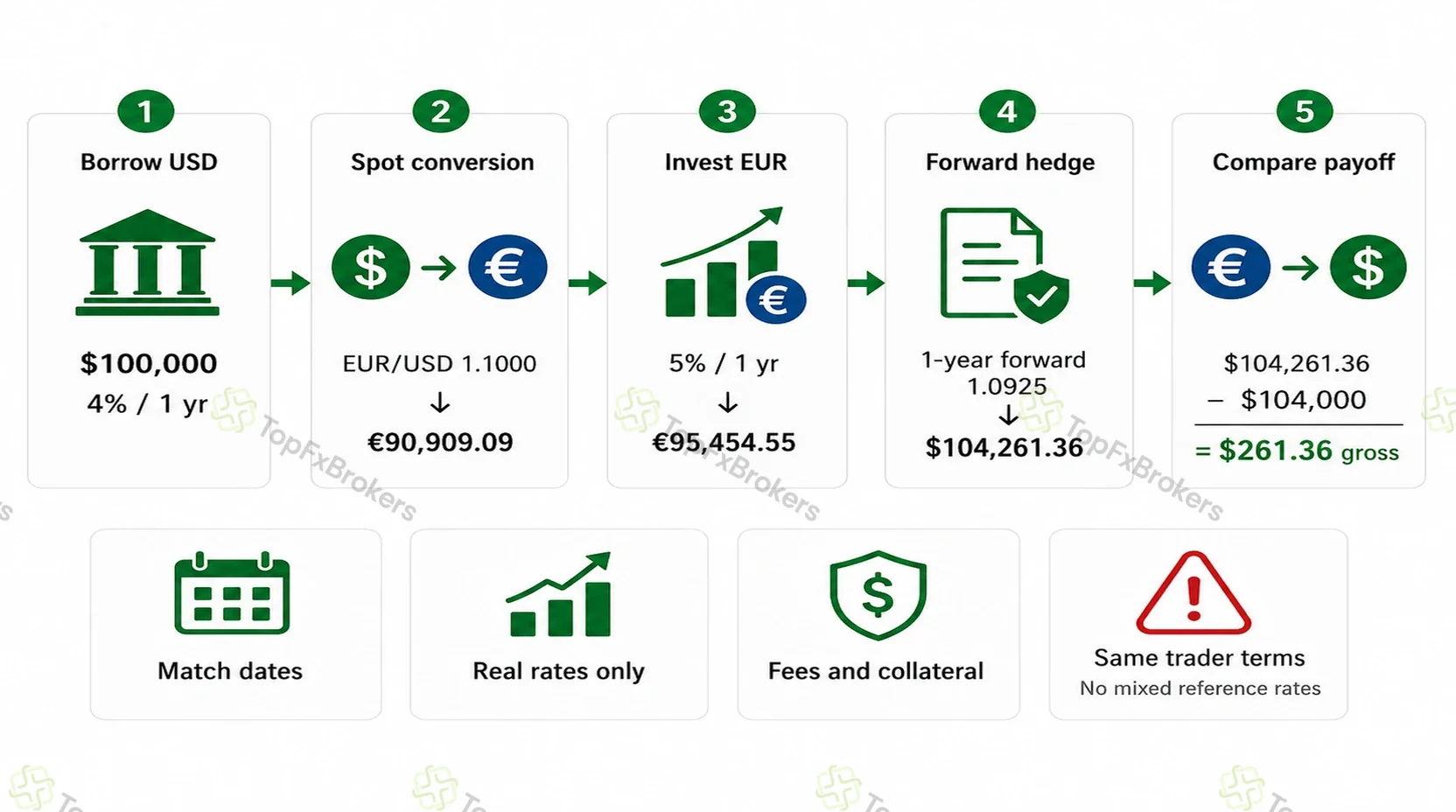
The trader borrows one currency, converts it at the spot rate, invests the proceeds in another currency and uses a forward contract to lock the future conversion back into the original currency.
Suppose a trader borrows $100,000 for one year at 4%, converts the dollars into euros at EUR/USD 1.1000 and invests the resulting €90,909.09 at 5%. The euro investment grows to approximately €95,454.55.
A one-year forward contract is then used to sell those euros for dollars at 1.0925. The forward would return approximately $104,261.36, while the dollar loan requires repayment of $104,000. The gross difference is about $261.36 before fees, collateral, settlement charges and differences between displayed and accessible rates.
The dates and cash flows must align. The loan, foreign investment and forward contract should mature together. The calculation must also use the rate at which the trader can actually borrow, the rate available on the investment and the executable side of the forward quote.
A public reference rate cannot automatically be combined with a retail borrowing rate or a theoretical forward price. Using terms that are not available to the same trader can create an artificial opportunity.
Covered Interest Arbitrage vs Carry Trading
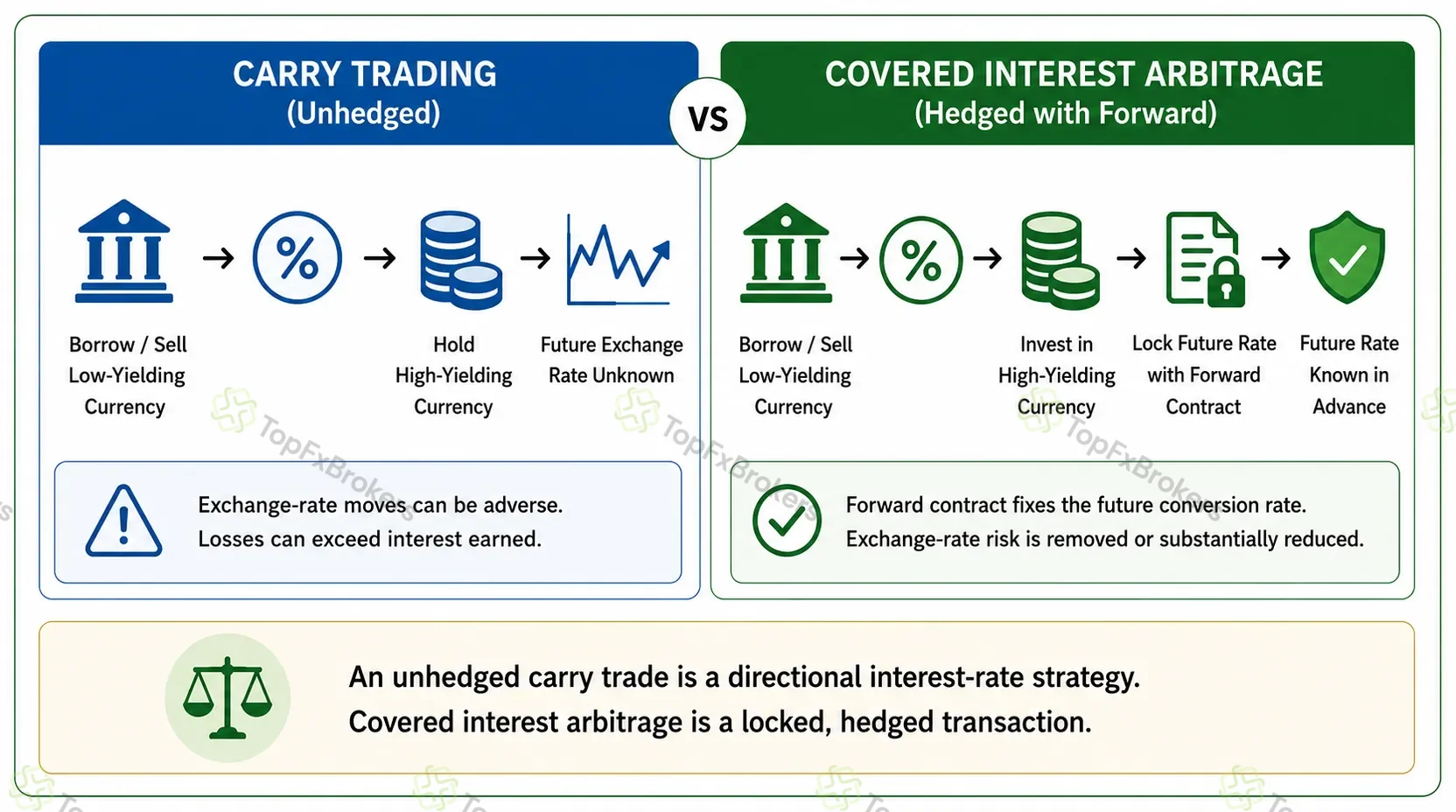
A carry trade borrows or sells a lower-yielding currency and holds a higher-yielding one without fully fixing the future exchange rate. An adverse currency move can outweigh the interest earned.
Covered interest arbitrage uses a forward contract to determine the future conversion rate in advance. Its purpose is to remove or substantially reduce that exchange-rate uncertainty.
An unhedged carry trade is therefore a directional interest-rate strategy, not a locked arbitrage transaction.
Spot-Futures Arbitrage
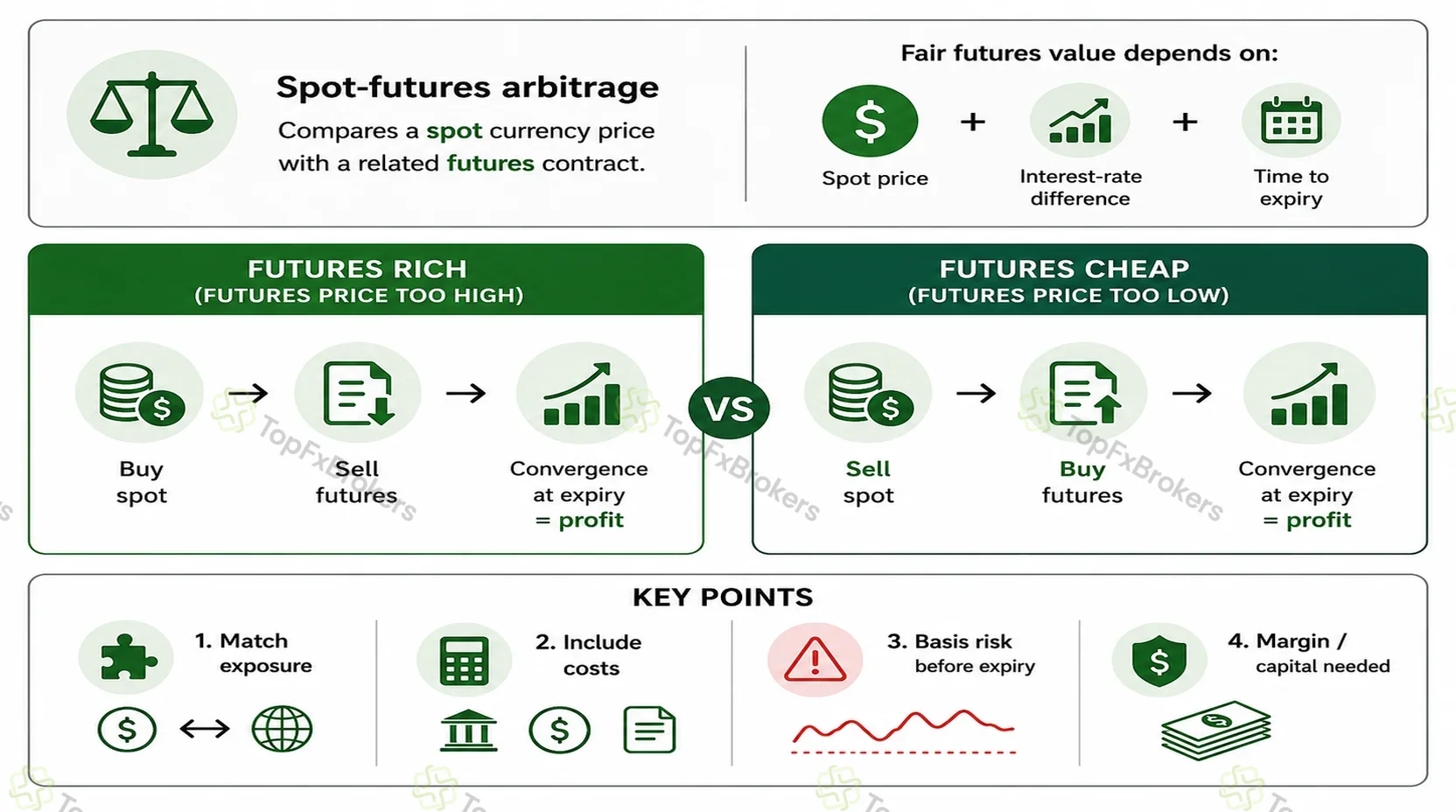
Spot-futures arbitrage compares a spot currency price with a related currency-futures contract.
Futures prices are influenced by the spot rate, the interest-rate difference between the two currencies and the time remaining until expiry. A futures contract can therefore trade above or below spot without being mispriced.
When futures appear too expensive relative to the adjusted spot value, a trader may buy the spot exposure and sell futures. When futures appear too cheap, the direction may be reversed.
The hedge must use compatible exposures. Currency futures have standardized contract sizes and specified expiry months, while a spot position can usually be sized more flexibly. Any unmatched quantity creates residual exposure.
The calculation must also include spot financing, futures commissions, exchange fees, margin requirements, settlement terms and differences in trading hours.
Convergence is most direct as the futures contract approaches settlement. Closing before expiry introduces basis risk because the difference between spot and futures may widen before it narrows.
A position that is expected to profit at settlement can still face interim losses and margin calls. Spot-futures arbitrage therefore requires enough capital to support the trade rather than relying only on eventual convergence.
Forex Arbitrage Tools, Calculators and Automated Execution
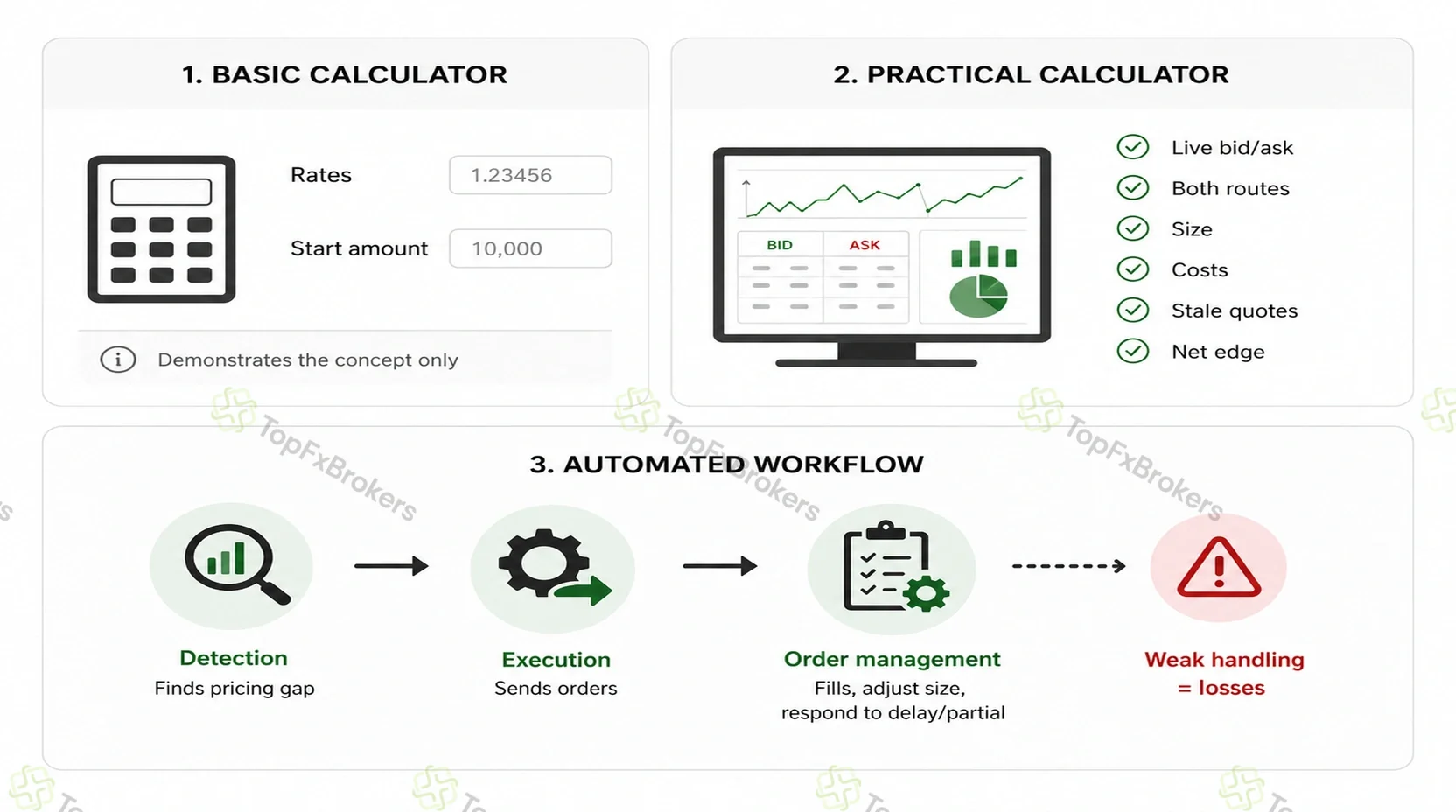
Forex arbitrage tools range from educational conversion calculators to automated systems that receive live prices and manage orders across several venues.
A basic triangular calculator may accept three exchange rates and a starting balance. That can demonstrate the concept, but it does not establish whether the route is tradeable.
A practical calculator should use synchronized bids and asks, evaluate both conversion directions, account for available size and include commissions, expected slippage and other costs. It should also identify stale quotes and separate the gross discrepancy from the estimated net edge.
Detection is only one part of an automated system.
Detection software finds a possible pricing inconsistency.
Execution software converts the signal into orders and sends them to the required venues.
Order-management logic confirms fills, adjusts quantities and responds when one order is delayed, rejected or partially completed.
A fast scanner without dependable order management can identify opportunities correctly while still producing losses during live trading.
Order Types and Execution Trade-Offs
Market orders prioritize completion but may fill at worse prices than expected.
Limit orders control the worst acceptable price but may remain unfilled. An immediate-or-cancel instruction fills whatever quantity is immediately available and cancels the rest, which can still leave an unmatched position.
A fill-or-kill instruction, where supported, requires the complete amount to execute immediately or cancels the order. It can reduce partial fills but may lead to more rejected transactions.
No order type guarantees both the detected price and complete execution. Greater price protection usually increases the chance that part of the arbitrage will not fill. Greater completion certainty can expose the trade to more slippage.
An automated process should therefore define acceptable quote age, maximum slippage, position limits, cancellation rules and an emergency procedure for neutralizing exposure.
Is Forex Arbitrage Risk-Free?
Forex arbitrage is risk-free only in a theoretical model where all transactions execute simultaneously, completely and at known prices without costs.
Live markets do not meet those assumptions.
The most important risk is incomplete execution. One position may fill while another is rejected, delayed or only partially completed. A strategy intended to be neutral then becomes exposed to market direction.
Prices can also change between detection and execution. Because the expected gains are often small, a fraction of a pip of additional slippage may remove the entire advantage.
Displayed liquidity can disappear or support only part of the intended trade. Larger orders may move through several price levels, producing an average fill that no longer supports the calculation.
Arbitrage opportunities also attract competing orders. Buying at the lower price and selling at the higher one pushes the markets back toward alignment. Automated participants can consume favorable liquidity almost immediately.
During major announcements, larger discrepancies may appear, but quotes are less stable and spreads can widen sharply. A bigger visible gap does not necessarily mean a safer or more profitable opportunity.
Margin and funding create further constraints. Cross-broker strategies require capital in separate accounts. Spot-futures positions may face interim margin calls. Covered interest trades depend on borrowing and collateral terms.
Technology can fail as well. A delayed feed, clock mismatch, duplicate order, incorrect symbol mapping or lost connection can create unintended exposure.
Broker and venue rules must also be considered. Account terms may address stale prices, obvious quote errors or particular automated execution methods. Policies vary, so a trader should review the conditions governing each account.
Can Retail Traders Use Forex Arbitrage?
Retail traders can study currency relationships, compare broker quotes, calculate implied cross-rates and simulate arbitrage strategies.
Consistent live execution is harder.
Professional participants may receive faster data, access deeper liquidity and route orders directly to several venues. Retail quotes can contain additional markups or come from a more limited liquidity pool.
Capital must also be available where each trade occurs. Cross-broker arbitrage may require independently funded accounts. Futures positions require margin, while covered interest strategies may depend on borrowing and forward-market access.
The maximum trade size is limited by the smallest executable quantity across all required legs, not simply by the trader’s desired exposure.
For triangular arbitrage, later orders should be based on the amount actually received from the previous conversion. If the first order fills only partially, submitting the original planned size on the next leg can create an oversized position.
For cross-broker arbitrage, both accounts need sufficient free margin. A profit at one broker cannot immediately resolve a shortage at the other.
Retail traders can perform the calculations manually, but brief opportunities are usually difficult to capture that way. Automation improves speed, although it also introduces software, data and order-management risks.
A high number of detected discrepancies does not prove that a strategy is viable. The relevant measure is how many transactions can be completed at executable prices and remain profitable after failed attempts are included.
How to Test a Forex Arbitrage Strategy
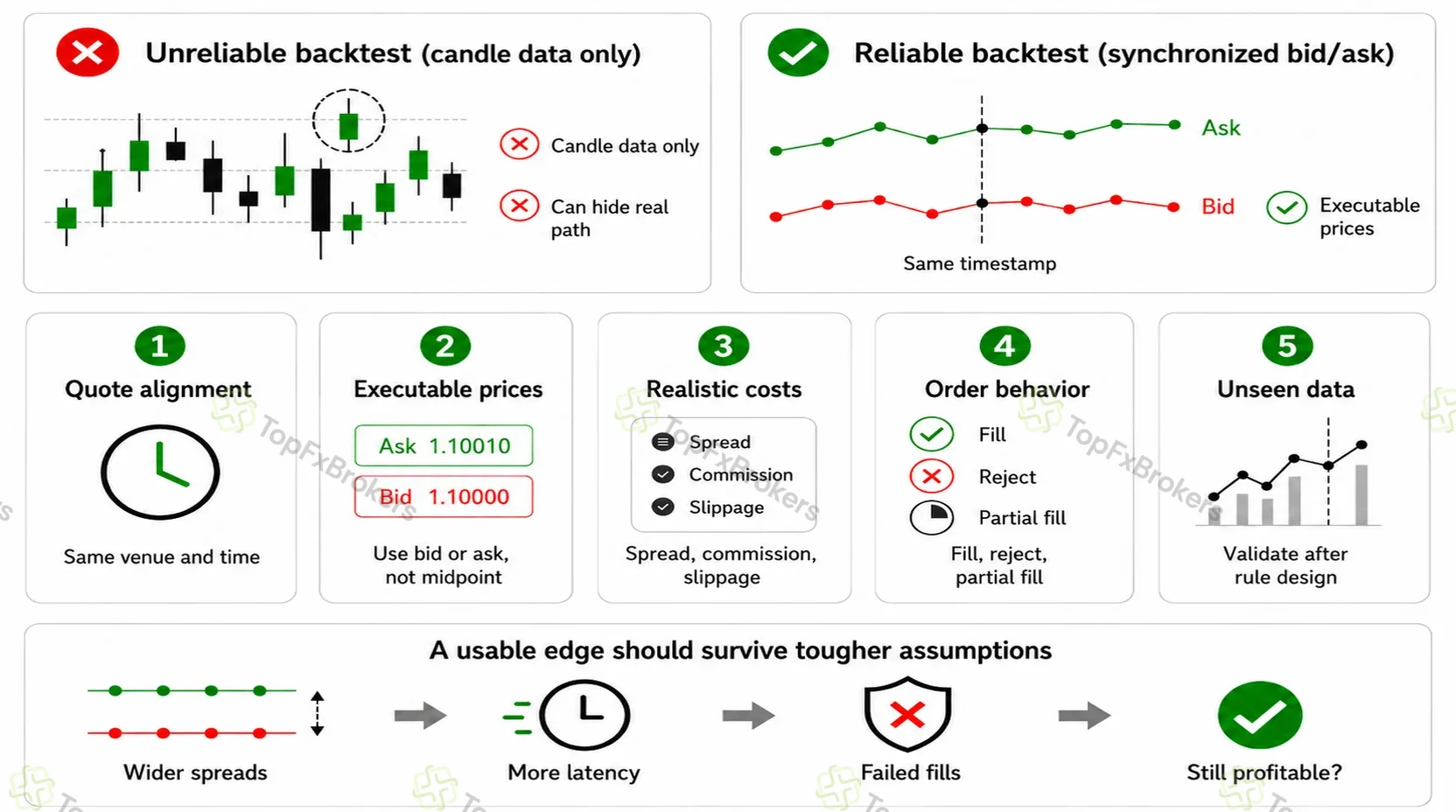
An arbitrage backtest should reproduce the execution process rather than compare historical chart prices.
Ordinary candle data are generally inadequate because discrepancies can appear and disappear within one candle. Testing should use synchronized bid and ask quotes at a resolution suited to the strategy.
| Testing area | What should be modeled |
|---|---|
| Quote alignment | Comparable timestamps, venues, account conditions and instrument specifications |
| Executable pricing | Correct bid or ask for each trade and realistic available quantity |
| Costs | Spreads, commissions, markups, financing, closure and account rebalancing |
| Order behavior | Latency, slippage, partial fills, rejections and cancellation rules |
| Market conditions | Active sessions, quiet periods, announcements, rollover and spread widening |
| Evaluation | Rules developed on one dataset and tested on previously unseen data |
Clock synchronization deserves particular attention. A consistently delayed feed can create historical price differences that were never available at the same time.
Each order should be simulated using the applicable bid or ask. The model should include the delay between detecting the signal, submitting the orders and receiving the fills.
Failed trades must remain in the results. Excluding partial fills, rejected legs and emergency exits can make an impractical strategy appear profitable.
Results should also be separated by session and market conditions. A strategy may behave differently during the London–New York overlap, quiet overnight trading, rollover or major economic announcements.
Rules should be designed on one period and evaluated on unseen data. A strategy that works only with one exact quote-age limit or minimum-edge threshold may be fitted to historical noise.
Useful measures include the number of detected discrepancies, the percentage available at sufficient size, completed transactions, failed-leg rate, average opportunity duration, realized slippage, net profit after costs and maximum temporary currency exposure.
Performance should also be recalculated using wider spreads and greater latency. A strategy that fails after a minor deterioration in assumptions has little practical margin for error.
Forex Arbitrage vs Statistical Arbitrage and Carry Trading
These strategies are sometimes grouped together, but their risk structures differ.
| Strategy | Source of return | Is the return locked immediately? |
|---|---|---|
| Forex arbitrage | A current pricing inconsistency between equivalent exposures | Potentially, when every leg is executable |
| Statistical arbitrage | Expected convergence of a modeled relationship | No |
| Carry trading | Interest-rate income and currency movement | No |
Statistical arbitrage may buy one currency exposure and sell another because their historical relationship has diverged. The trade expects convergence, but the relationship can continue moving apart.
Carry trading attempts to benefit from an interest-rate difference while remaining exposed to exchange-rate changes.
True arbitrage instead attempts to capture a present pricing inconsistency through offsetting transactions. In practice, however, execution risk can prevent the theoretical return from being secured.
Does Forex Arbitrage Still Work?
Pricing inconsistencies can still arise between brokers, connected currency pairs, funding markets and related instruments.
The more important question is whether they can be executed profitably.
Direct opportunities are heavily competed. Prices may realign before an order arrives, and the best quote may contain less volume than the strategy requires. Spreads, commissions and slippage can consume an apparent advantage.
For general traders, two different displayed prices are not enough. The complete transaction must be executed at the correct bid and ask prices before the relationship changes.
Historical calculations based on midpoint prices, delayed feeds or unsynchronized quotes do not demonstrate that the opportunity was tradeable.
Forex arbitrage can work when the pricing relationship is defined accurately, the data reflect executable conditions and every required order can be managed while a positive net edge remains.
Conclusion
Arbitrage trading in forex involves more than finding prices that differ. The discrepancy must survive executable bid and ask prices, available liquidity, transaction costs and the time required to complete each trade.
Cross-broker and triangular arbitrage provide the clearest spot-market examples, while covered interest and spot-futures arbitrage apply the same principle to funding and derivative relationships. In every case, a visible difference becomes completed arbitrage only when all required transactions fill, the exposure is neutralized and a positive net result remains.
FAQ
What Is Triangular Arbitrage in Forex?
Triangular arbitrage uses three connected currency pairs. A trader converts one currency into a second, the second into a third and the third back into the starting currency. An opportunity exists only when the final amount exceeds the starting balance after the correct bid and ask prices, transaction costs and available liquidity are considered.
How Does a Forex Arbitrage Calculator Work?
A forex arbitrage calculator compares related prices and estimates the result of a conversion route. A realistic tool should use synchronized bids and asks, evaluate both directions, account for trade size, commissions and slippage, and distinguish a theoretical price difference from an executable net result.
Is Forex Arbitrage Risk-Free?
Not in live markets. Quotes can change, orders can be rejected and available liquidity may be smaller than expected. When one part of the transaction fills while another fails, the trader can be left with an unintended directional position.
How Much Capital Is Needed for Forex Arbitrage?
There is no universal minimum. The requirement depends on trade size, margin rules, transaction costs and the number of accounts or instruments involved. Cross-broker strategies may require capital at multiple venues, while futures and covered interest methods can require additional margin or collateral.
Can Retail Traders Use Forex Arbitrage?
Retail traders can monitor prices, calculate cross-rates and test arbitrage systems. Consistent live execution is more difficult because brief opportunities may require synchronized data, fast order routing, sufficient capital and reliable controls for partial or failed execution.
Is Forex Arbitrage Legal, and Do Brokers Allow It?
Arbitrage is not inherently the same as manipulation or fraud. However, laws, products and account terms differ by jurisdiction and provider. Some brokers may restrict trading based on stale quotes, obvious pricing errors or particular automated methods, so the applicable agreement should be reviewed.

Written by:
Asmae Amrani
Asmae contributes broker reviews, educational resources, trading strategy articles, and industry insights for TopFxBrokers. Her work combines detailed research with clear explanations, helping readers compare trading platforms, understand market concepts, and stay informed about the evolving financial landscape.
She is committed to producing accurate, impartial, and well-researched content that empowers traders to make confident, well-informed decisions.